Few areas of Washington State probate litigation are governed by more exacting procedural requirements than will contests.
When a family member believes a will does not reflect the decedent’s true intent, the first instinct is often to focus on the facts: How did the will change? Who was involved? Was there undue influence or an issue with capacity? But before a court can reach the merits, Washington law imposes strict requirements governing the timing and service of will contests. Washington courts have rigorously enforced those requirements for more than a century.
As a result, the first question for anyone evaluating the strength of a potential will contest is not whether the challenge can be proven, but whether it can still be brought.
Bottom Line: A petitioner bringing a will contest must file it with the court within four months after the will’s admission to probate and must personally serve the estate’s personal representative within 90 days after filing. Missing either requirement is fatal to the case.
What Is the Deadline for Bringing a Will Contest?
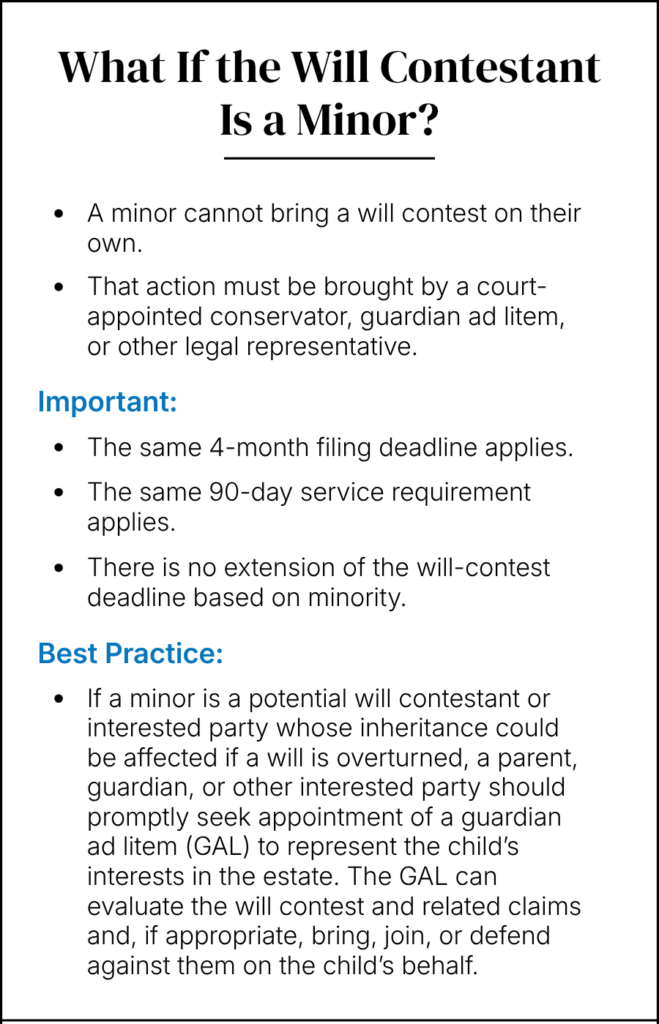
A will contest is a petition that challenges the validity of a will after its admission to probate. Most will contests involve allegations of undue influence, lack of testamentary capacity, fraud, duress, or defects in execution. The petitioner is typically an heir, beneficiary, or other interested person whose financial interest would improve if the court declared the challenged will to be invalid.
Will contest procedure in Washington is governed primarily by chapter RCW 11.24 and the Trust and Estate Dispute Resolution Act (TEDRA), chapter RCW 11.96A.
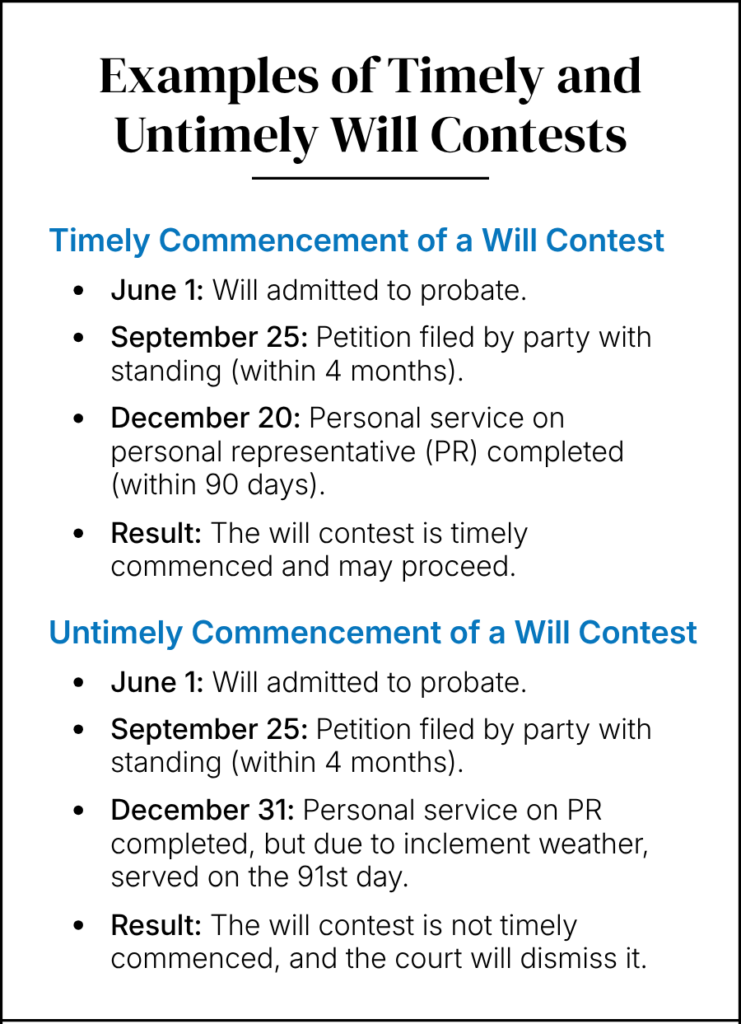
Under RCW 11.24.010, a petitioner must commence the will contest within four months after the will’s admission to probate. This four-month period operates as a statute of limitations. If a contest is not timely commenced, it is barred.
To timely commence a will contest under RCW 11.24.010:
- The petitioner must file the petition with court within four months after the will’s admission to probate; and
- The petitioner must personally serve the petition on the personal representative of the estate within 90 days after filing the petition.
If the petitioner meets both requirements, the contest is timely commenced, even when personal service occurs after the four-month deadline. But if the petitioner fails to meet either requirement, the will’s admission to probate becomes “binding and final,” and the will contest is barred.
Don’t Confuse RCW 11.24.010 with TEDRA’s Separate Notice Requirements
A petitioner in a will contest must comply not only with RCW 11.24.010’s filing and service requirements, but also with TEDRA’s separate notice and service provisions, including those found in RCW 11.96A.100 and RCW 11.96A.110. The two sets of requirements serve different purposes and carry different consequences if violated.
TEDRA requires an initial hearing on the will contest unless the court dispenses with that procedure and sets the matter for trial. Because the initial hearing may be dispositive and decided on the pleadings alone, proper notice and an opportunity to respond is critical for all interested parties. The petitioner must serve interested parties whose rights may be affected by the will contest’s outcome, such as heirs, beneficiaries, and the personal representative, with a TEDRA summons, a copy of the petition, all supporting materials filed, and a notice of the hearing. Service may be accomplished either by mail or in person. The petitioner must serve those documents on interested parties at least 20 days before the hearing, or 23 days before, if service is made by mail.
TEDRA’s notice and service requirements are distinct from the four-month statute of limitations requirements imposed by RCW 11.24.010. Failure to meet the statute of limitations deadlines is fatal to a will contest. By contrast, a defect in TEDRA service does not require dismissal. Instead, the court, in its discretion, may continue the initial hearing, or the petitioner may re-note it, to allow for proper service. The practical difference is significant: a TEDRA service problem usually delays the case, while a failure to comply with RCW 11.24.010 can end it.
Do Washington Courts Strictly Enforce the Four-Month Statute of Limitations?
Yes.
Although the length of the statute of limitations period has changed over the years—evolving from a one-year deadline that applied before 1917, to six months between 1917 and 1967, to four months since 1967—Washington courts have strictly enforced the deadline for over a century.
In State ex rel. Wood v. Superior Court of Chelan County (1913) the Washington Supreme Court halted a will contest filed just one day late. The Court held that courts have “no jurisdiction to hear and determine a contest begun after the expiration of the time fixed in the statute.”
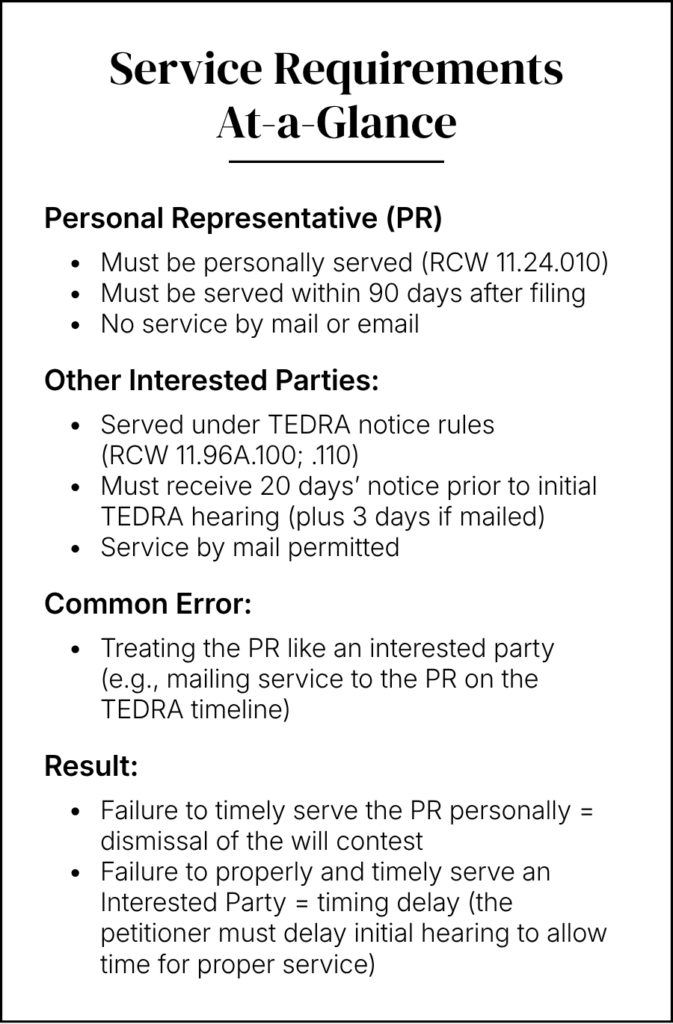
Decided more than 100 years after Wood, the case of In re Estate of Jepsen (2015) illustrates that timely service on the personal representative matters as much as timely filing. The will contestant filed on time, but instead of personally serving the personal representative, sent the petition by email to the personal representative’s attorney. Nothing in the record showed that the personal representative had agreed to accept service by email or through counsel.
After the 90-day service period expired, the personal representative moved to dismiss. The trial court denied the motion, and the Court of Appeals affirmed. In a 5-4 decision, the Washington Supreme Court reversed, holding that an email to counsel does not satisfy the statutory personal service requirement. Because the petitioner failed to complete timely personal service on the personal representative, the court dismissed the case.
From a litigation standpoint, Jepsen is a useful reminder that courts distinguish sharply between actual notice and legally sufficient service. The personal representative in Jepsen knew about the will contest within the 90-day period, but that actual knowledge was not enough to cure the service defect.
In the recent matter of In re Estate of Boswell (2021), the Court of Appeals affirmed dismissal of a will contest filed during the COVID-19 pandemic. The petitioner timely filed the petition but failed to personally serve the personal representative within 90 days, arguing that the governor’s stay-at-home orders prevented personal service. The court observed that the petitioner had approximately two months after filing—and before the onset of the pandemic—during which she could have completed personal service on the personal representative. Because she failed to act during that period, the court concluded that she had not exercised reasonable diligence. The court therefore sidestepped the question of whether equitable tolling could ever apply to RCW 11.24.010, holding that the petitioner would not have qualified for such relief in any event.
For practitioners, the lesson from Wood, Jepsen, and Boswell is straightforward. Washington courts consistently treat RCW 11.24.010 as a gatekeeping statute. Before investing substantial time in investigating the merits of a will contest, counsel should confirm that the filing and service requirements can be satisfied.
Are There Any Exceptions to the Four-Month Deadline?
There is one exception, but it applies only in limited circumstances.
Washington courts recognize a narrow, due process exception to the four-month statute of limitations for will contests when the personal representative fails to provide timely notice of the will’s probate to required parties.
The exception applies when:
- The will contestant belongs to the class of persons entitled to notice of the probate under RCW 11.28.237(1) (such as an heir or beneficiary);
- The personal representative fails to provide the required notice within 20 days after the personal representative’s appointment as required by RCW 11.28.237(1); and
- The will contestant has not waived the defective notice by obtaining actual knowledge of the probate and an opportunity to act.
If those three elements are met, then the four-month limitations period may be tolled.
Division One addressed this issue in In re Estate of Little (2005). There, the personal representative failed to provide notice of the probate to the decedent’s nieces and nephews, each of whom were in the class of persons entitled to receive notice under RCW 11.28.237. The estate was administered and closed without their knowledge, and they did not learn of the probate until years later.
The court held that the four-month limitations period did not begin to run as to the nieces and nephews. Because the notice failure constituted a due process violation that impacted their rights and interests in the estate, the four-month period was effectively tolled, the decree closing the estate was void as to those heirs, and their claims were not time-barred.
In re Estate of Vatne (2022) illustrates the limits of Little. There, the personal representative likewise failed to provide the notice of probate to an heir (a disinherited son), but unlike the claimants in Little, the son learned of the probate while it was still pending and filed a will contest within the four-month period. His contest nevertheless failed because he did not personally serve the petition on the personal representative within 90 days after filing. The Court declined to apply tolling and dismissed the son’s will contest, explaining that once a contestant had actual notice and an opportunity to act, the due process concerns underlying Little disappeared.
Taken together, Little and Vatne demonstrate that while tolling is possible, it is only allowed in rare and specific circumstances. The ordinary rule remains straightforward: once a person has notice and an opportunity to act, RCW 11.24.010 governs.
When to Call a Lawyer
Washington’s will contest statutes leave little room for delay or procedural missteps. A claim that appears strong on the facts may never be heard if the statutory requirements governing filing and service are not met.
Before assessing the merits of a potential will contest, it is worth confirming that the deadlines have not already expired. Stokes Lawrence’s Trust and Estate Litigation team regularly represents beneficiaries, heirs, fiduciaries, and other interest parties in will contest and related trust and estate disputes throughout Washington. If you are considering filing a will contest or are facing one, we invite you to contact us.
Disclaimer. This article is provided for general informational purposes only and does not constitute legal advice or a legal opinion. Every matter is different, and case outcomes depend on the specific facts and circumstances of each situation. Although Stokes Lawrence, P.S., strives to ensure the accuracy of the information presented, the law is continually evolving, and the information contained herein may not reflect the most recent legal developments or the current state of the law. You should consult competent legal counsel licensed in the appropriate jurisdiction regarding your particular circumstances. Reading, accessing, or relying on this article or website does not create an attorney-client relationship with Stokes Lawrence, P.S.